Eventually I gave up buying a new Walkman or other separated portable music player (DAP). No matter how magical nostalgia might be, I have to admit that DAP is absolutely obsolete in the Reiwa era.
Since I sold my Walkman on Mercari 2 years ago and started to use bluetooth earbuds, I was always seizing an opportunity to have a DAP again. The chance came last month when I accidentally lost my Sony bluetooth earbuds, and I bought a pair of wired Sennheiser ones instead. The sound quality of Sennheiser’s is gorgeous, that’s something wireless technology just isn’t able to deliver.
My current music player is the iPhone 11. To be honest, objectively I don’t have too many problems with it other than the clumsy headphone jack dongle. There were two issues I wanted to improve.
First, the battery goes down noticeably faster while using wired earbuds. Normally, I would go to work with 50% battery life without worry, but now it became a risky move because it is highly possible that the battery will die around early evening without charging.
Second, I had doubts about the iPhone’s sound quality. After Apple removed the headphone jack from every new iPhone, they also removed DAC/Amp chips from the logic board entirely. It may sound hilarious, but it is not the iPhone itself that processes sound output via headphone jack, but the dongle. There are tiny DAC/Amp chips inside the small dongle confirmed by major tech media outlets. I thought I could expect a big sound quality improvement from a legit DAP.
Presently, Walkman has 4 lines on sale, which are the WM series, ZX series, A series, and the S series. WM is for rich people, ZX is for heavy audiophiles and A is for ordinary people who seek better sound quality. Unfortunately I don’t know who the Series is targeting. I put my emphasis mainly on A series, A50, and A100 in specific. A50 and A100 have similar designs. They are both tiny, light, and well made. The biggest difference among them is that A100 runs on Android OS. Despite A50 runs on old-fashioned original OS, it is not necessarily a bad thing because it consumes far less power than any smart OS. After hours of research and even going to Yodobashi to test things myself, all I got were disappointments.
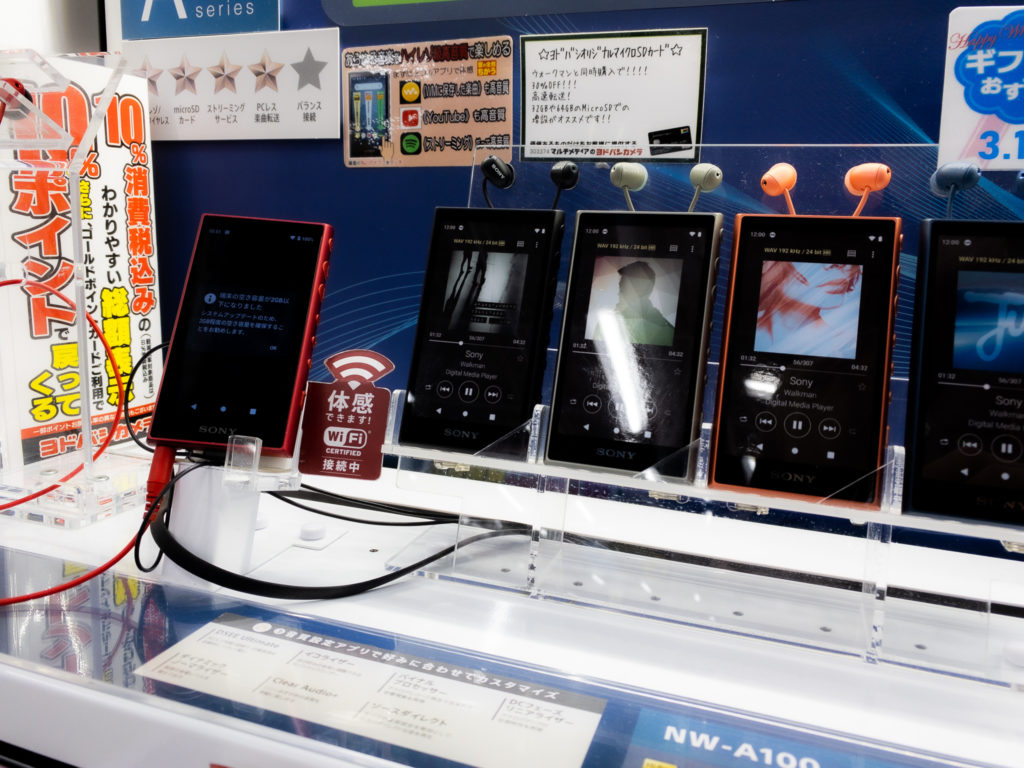
Let’s start with the A50. The A50 is a decent device … by the early 2010s’ standard before music streaming services started to dominate the industry. Since it runs on a proprietary OS, the A50 doesn’t support any streaming services. Users need to collect music files either from CDs or the Internet like the old days. However, if the A50 is indeed able to deliver good sound, I believe it’s still a worth owning device for music lovers. Sadly, A50’s sound quality is mediocre. I compared the A50 with the A100 and my iPhone side by side with the same earbuds (Sennheiser) and the same songs. Despite the fact that A50 was playing a Hi-Res version of the test songs, it sounded almost the same as my iPone with Apple Music (AKA 256kbps AAC files). In Youtuber Techmoan’s non-sponsored review about the A50, he pointed out the unexpected mediocre sound quality issue as well.
Unlike the A50, defected by a ¥1,100 headphone dongle, the A100 showed better resistances. It supports streaming services like any Android device. The sound quality advantage finally kicks in. A100’s sound is apparently more rich and wider than iPhone’s. Subjectively, I will say it’s a 20% improvement. Other than sound quality, the rest once again falls off the cliff. Because it runs on Android OS, the battery life is complete garbage. I never saw Sony make any Android devices with decent battery life, so it was foreseeable. The OS experience is choppy even for a music player. The deal breaker is the price. The cheapest model of A100 is A105 which costs around ¥34,000. With this kind of budget, buying a pair of high-end earbuds or headphones can easily get over 50% sound improvements.
Compared to seeking better listening experiences, I think many people including me have feelings for Walkman more for nostalgia. Once Walkman became popular, it was as if everyone had one. Until the 2010s, average people were still buying Walkman devices in Japan. It was deep in the culture. In the animation Evangelion, the protagonist Shinji used a Walkman which had a profound influence on my childhood. When I think about walkman, the scenes of Evangelion and the rhythms of its theme song always come to my mind. Maybe that’s the true reason why I stick with it.
Like the iPod, Walkman could have its place in modern culture not only because it’s cool, but also because it actually fulfills people’s needs for a period of time. Nowadays, Walkman is no more than a luxury toy. Maybe the point is not about buying a new Walkman or not, it’s about letting the past go and embracing the future.
